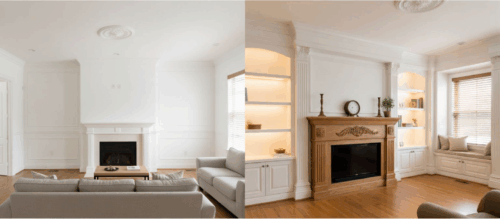
Custom millwork and design refers to architectural woodwork manufactured to exact specifications for a particular project—from replicating century-old crown molding profiles to building entertainment centers that fit a wall down to the sixteenth of an inch. Unlike stock trim from home improvement stores, custom work gives you control over wood species, profile shapes, dimensions, and finishes, allowing you to match existing details in renovations or create distinctive architectural character in new construction.
This guide covers what custom millwork actually is, how it transforms residential spaces, which rooms benefit most from custom details, the technical capabilities that make profile matching possible, and what contractors need to know about timelines and costs.
What Is Custom Millwork and Design
Custom millwork refers to wood architectural elements made to exact specifications for a particular project. Unlike stock trim you can buy off the shelf at a home improvement store, custom millwork gets manufactured specifically for your space—whether that means replicating a crown molding profile from a 1920s home or building a bookcase that fits a wall down to the sixteenth of an inch.
The “design” part involves both the aesthetic vision and the technical planning that makes everything work together. You’re selecting wood species, determining profiles, coordinating finishes with doors and hardware, and figuring out how each piece relates to the room’s proportions. Common types of custom millwork include baseboards, crown molding, door and window casings, wainscoting, coffered ceilings, built-in cabinetry, fireplace surrounds, and stair components.
What separates custom millwork from standard products comes down to control over every detail. You can specify the exact wood type, the profile shape, the dimensions, and the finish. For contractors working on renovations where matching 80-year-old baseboard becomes critical, this flexibility means you can replicate profiles that haven’t been manufactured in decades.
Why Custom Millwork Transforms Living Spaces
Custom millwork changes how a space looks and functions by adding architectural detail that stock trim simply can’t deliver. The transformation happens across several dimensions that affect both immediate visual impact and long-term property value.
Enhanced Architectural Character
Plain drywall becomes a distinguished room when you add well-designed trim details. Crown molding creates a visual transition between walls and ceilings, adding depth and shadow lines that make ceilings feel higher and rooms more finished. Wainscoting breaks up large wall surfaces with horizontal lines and texture that ground the space visually.
The key advantage of custom work lies in scaling these details appropriately for each room. A 10-foot ceiling can handle a 6-inch crown profile, while an 8-foot ceiling looks better with something more delicate. Stock molding comes in limited sizes that often don’t relate properly to room proportions, but custom profiles get designed to feel balanced within their specific context.
Seamless Flow Between Rooms
When the same baseboard, casing, and crown profiles carry from room to room, the architecture feels intentional rather than pieced together. This consistency becomes especially important in additions or renovations where new construction sits next to existing spaces. Custom milling capabilities allow you to match existing trim exactly, so the addition doesn’t announce itself as obviously newer work.
For builders working on whole-house projects, establishing a millwork package early ensures that every room relates to the others through consistent detailing. This approach also simplifies ordering and installation since the same profiles repeat throughout.
Increased Property Value
Quality millwork becomes a permanent fixture that distinguishes a property when it comes time to sell. Built-in bookcases, coffered ceilings, and detailed door casings signal craftsmanship that buyers recognize and value. The work doesn’t depreciate the way paint colors or light fixtures might—well-executed millwork remains an asset that future owners appreciate.
From a builder’s perspective, custom millwork differentiates your projects and justifies premium pricing in competitive markets. It’s an investment that separates your work from developments using standard builder-grade trim throughout.
Rooms and Features That Benefit Most From Custom Millwork
While custom millwork can enhance virtually any space, certain rooms and architectural features deliver the most dramatic impact. Understanding where to focus your millwork budget helps you create maximum visual effect while addressing functional storage needs.
Kitchens and pantries benefit from decorative panels that hide refrigerators and dishwashers, making appliances disappear into the cabinetry. Custom range hoods, furniture-style cabinet bases, and elaborate crown molding transform kitchens from purely functional spaces into showpiece rooms. Butler’s pantries particularly benefit from custom built-ins that maximize storage in compact footprints, with shelving sized precisely for serving pieces and small appliances.
Living room built-ins—entertainment centers, bookcases, and fireplace surrounds—gain significant impact when designed as integrated architectural elements rather than freestanding furniture. Custom work can incorporate hidden storage, display lighting, and media equipment while appearing as permanent features that belong to the architecture. Flanking a fireplace with built-in cabinetry creates symmetry and anchors the room’s focal point with substantial detail.
Coffered ceilings add vertical interest to dining rooms, studies, and primary bedrooms through their grid of recessed panels framed by beams. The three-dimensional quality creates shadow lines that shift throughout the day as light changes, making the ceiling an active part of the room’s character. Decorative ceiling medallions centered over chandeliers or beam work that defines zones within open-concept spaces similarly transform what’s typically ignored into architectural features.
Staircases occupy prominent positions in entries and hallways, making them natural opportunities for custom millwork that functions almost like sculpture. Custom newel posts, balusters, and handrails can be designed to match the home’s overall aesthetic—traditional turned balusters, contemporary metal and wood combinations, or craftsman-style square posts. The staircase often becomes a focal point that sets the tone for the entire home.
Door surrounds with elaborate casings, backbands, and plinth blocks frame doorways as significant architectural moments rather than simple openings. You can scale casings to match the importance of the room they introduce—wider, more detailed trim for formal spaces, simpler profiles for secondary areas.
Our CNC and Profile Matching Capabilities
The technical capabilities behind custom millwork determine what’s actually achievable when you’re trying to match existing work or create complex profiles. Modern CNC (Computer Numerical Control) equipment combined with traditional knife-grinding expertise allows millwork shops to replicate virtually any profile and produce it consistently across large quantities.
Knife Grinding for Exact Profile Replication
Profile matching starts with creating custom knives—steel cutting tools ground to the exact reverse shape of the molding profile you want. When you provide a sample of existing trim, the profile gets traced or scanned, and a knife gets ground to replicate it precisely. This process allows you to match historical moldings that haven’t been manufactured in decades or create entirely new profiles designed specifically for your project.
The accuracy matters particularly in renovation work where new trim needs to blend invisibly with original millwork. A knife ground from your sample will produce molding that matches the original down to subtle details that stock profiles never quite capture.
Exotic Woods and Veneers
Beyond standard pine and poplar, custom millwork shops can work with premium species like white oak, walnut, cherry, and mahogany. Wood selection affects both the final appearance—grain pattern, natural color, and how the piece accepts stain—and durability for high-traffic applications.
Veneered products allow you to achieve the look of expensive solid wood in panel applications where veneer over stable substrate actually performs better than solid wood by resisting warping. Cabinet doors and wainscoting panels often work better as veneered products than solid wood for this reason.
In-House Finishing Booth
Controlled finishing environments ensure consistent color and sheen across all pieces in a project. Pre-finished millwork eliminates job-site finishing odors and dust, speeds installation, and guarantees that the baseboard in the living room matches the baseboard in the bedroom exactly.
The finishing booth also allows for more complex finishes—glazing, distressing, or multi-step processes—that would be impractical to execute on site. You get professional results without dedicating job-site time to finishing work.
Step-By-Step Process From Concept to Installed Trim
Understanding the workflow for custom millwork helps you plan timelines and coordinate with other trades. The process moves through distinct phases, each requiring specific information before proceeding to the next step.
1. Plan and Sample Review
The process begins when you submit door schedules, architectural drawings, and any existing samples of trim to be matched. These documents allow the millwork shop to understand the scope, quantities, and specific requirements of your project. If you’re matching existing work, providing a physical sample or detailed photos ensures accuracy—a 6-inch piece of the existing baseboard tells the shop everything they need to know about the profile.
2. Shop Drawings and Approval
Detailed shop drawings show the exact profiles, dimensions, and construction details for every millwork component in your project. These drawings serve as the contract between you and the shop, confirming that what gets built matches your expectations. Reviewing and approving shop drawings before production begins prevents costly misunderstandings and ensures that custom pieces will fit properly during installation.
3. Milling and Finishing
Production begins once shop drawings get approved, with raw lumber moving through the milling process to become finished components. CNC equipment and custom knives shape the profiles, pieces get sanded smooth, and everything moves to the finishing booth for staining or painting. Quality custom work involves multiple steps—priming, sanding between coats, final finish coats—that create durable, professional results.
4. Quality Check and Packaging
Before shipping, every piece gets inspected to ensure it meets specifications and quality standards. Shops carefully package components with protective wrapping and organize them by room or installation sequence to simplify the contractor’s job. Proper packaging prevents damage during transport and makes it easy to locate specific pieces when you’re ready to install.
5. Job-Site Delivery
Delivery timing coordinates with your construction schedule, arriving when you’re ready to install but not so early that millwork sits on site exposed to construction conditions. Many shops offer flexibility in delivery—bringing everything at once for larger projects or staging deliveries as different phases become ready for trim work.
Lead-Times, Costs, and Fast-Track Options
Planning for custom millwork requires understanding realistic timelines and how various factors influence both scheduling and pricing. While custom work inherently takes longer than pulling stock material off a shelf, experienced shops can often accommodate tight schedules when necessary.
Standard Production Schedules
Typical lead times for custom millwork range from two to six weeks depending on project complexity, material availability, and the shop’s current workload. Simple profiles in standard woods move faster than elaborate designs in exotic species. Finishing adds time—pre-finished millwork requires drying time between coats and quality control that can’t be rushed.
Communicating your required delivery date early in the process allows the shop to schedule production appropriately and flag potential conflicts before they become problems.
Same-Day Stock Runs
For common profiles that shops run regularly, same-day or next-day delivery often becomes possible when you need material quickly. Standard baseboards, casings, and crown moldings in pine or poplar typically fall into this category. Having a supplier who maintains inventory of frequently used profiles gives you flexibility when schedules compress or you need to address field changes quickly.
Budgeting by Linear Foot
Custom millwork pricing typically works on a per-linear-foot basis, with costs varying based on profile complexity, wood species, and finish requirements. Simple painted pine baseboards cost considerably less per foot than elaborate stain-grade walnut crown molding.
When budgeting projects, providing detailed takeoffs—the total linear feet of each profile type—allows suppliers to price accurately and helps you understand where costs concentrate. You might discover that upgrading to a more substantial baseboard profile adds less to the total budget than you expected because the linear footage in a typical home is relatively modest.
Integrating Custom Doors, Hardware, and Millwork for One-Stop Supply
Coordinating architectural elements through a single supplier simplifies project management and ensures that doors, trim, and hardware work together as a unified system. For contractors juggling multiple vendors, consolidating components reduces coordination headaches and potential compatibility issues.
- Pre-hung door packages: Complete door units arrive with jambs, hinges, and casings already coordinated and ready to install, eliminating field assembly time.
- Coordinated hardware finishes: Door hardware—hinges, handles, and accessories—gets matched to millwork finishes rather than clashing with them.
- Single invoice logistics: Consolidated billing and delivery scheduling through one vendor simplifies accounting and job-site coordination.
When the same supplier provides both doors and millwork, casing profiles can match baseboard and crown throughout the house, creating visual consistency that’s harder to achieve when sourcing from multiple vendors.
Ready to start your project? Contact us today for a consultation and quote on your custom millwork needs.
Ready To Elevate Your Project? Contact Authentic Moulding & Door Supply
Authentic Moulding & Door Supply has served Long Island’s premier builders for nearly 25 years with in-house custom milling capabilities, profile matching expertise, and fast turnaround times that keep projects on schedule. Our experienced team works from your plans and door schedules to provide accurate estimates and can often deliver same-day for standard profiles.
Whether you’re matching historic trim for a renovation or designing custom millwork for new construction, we offer the technical capabilities and personalized service that contractors depend on. We’re the one-stop partner for mouldings, doors, and hardware—coordinated and delivered when you need them.
Frequently Asked Questions About Custom Millwork and Design
- How do I get an exact estimate for custom millwork?
Provide us with your door schedule and architectural plans, along with any existing samples for profile matching. Our experienced team reviews your project requirements and delivers detailed pricing based on linear footage and complexity. - Can you match a historic profile from a photo or sketch?
Yes, our in-house knife grinding capabilities allow us to replicate virtually any existing molding profile. We can work from physical samples, detailed photos, or technical drawings to create exact matches. - Do you deliver custom millwork outside Long Island?
While we primarily serve Long Island builders and contractors, we can arrange shipping for custom millwork projects in surrounding areas. Contact our team to discuss delivery options and logistics for your specific location.