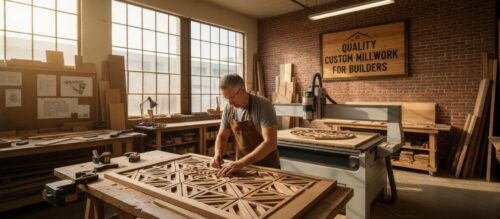
Custom millwork separates high-end builds from production housing—the difference between trim that fits your architectural vision exactly and stock profiles that force compromise. For builders working on renovations, custom homes, or projects where details drive value, knowing how to source quality millwork efficiently affects both your timeline and your bottom line.
This guide covers how custom millwork works from quote to delivery, when it makes sense over stock options, and what to look for in a supplier who can match profiles, meet deadlines, and deliver complete trim packages without the usual coordination headaches.
The Custom Millwork Advantage for Builders
Custom millwork refers to wood trim products—mouldings, casings, baseboards, door jambs—that are fabricated to match specific profiles or dimensions rather than pulled from standard stock inventory. Builders turn to custom millwork suppliers when they’re matching existing trim in renovations, executing unique architectural details, or creating pre-fitted packages that eliminate field modifications. The key difference between custom and stock comes down to precision: stock profiles work fine for straightforward projects, but custom millwork gives you exact matches without forcing your trim crew to improvise on-site.
Think of it this way—stock moulding is like buying a shirt off the rack, while custom millwork is like getting one tailored to fit. Both get the job done, but one fits your project’s specific requirements without compromise.
Faster Install With Exact Fits
Pre-fitted millwork arrives cut to specification, which means your crew spends less time measuring and adjusting in the field. When mouldings match your plans exactly, installation becomes placement rather than fabrication—your trim carpenters move through rooms faster, and you avoid delays from pieces that don’t fit or require rework.
This time savings adds up across a project. What might take a crew two days with stock material that requires field modifications often takes one day with pre-fitted custom pieces.
Design Freedom Without Field Alterations
Custom millwork allows you to execute complex details—curved casings, multi-piece crown assemblies, historically accurate profiles—without asking your crew to modify standard stock on-site. The fabrication happens in a controlled shop environment where precision equipment and experienced millworkers handle the complexity, which protects your timeline and ensures the result matches the design intent.
When the architect specifies a particular profile or the client wants something beyond basic trim, custom millwork delivers it without field compromise.
Stock vs Custom Profiles When to Choose Each
Stock profiles make sense for production builds with standard trim packages, tight budgets, and immediate material needs. Custom profiles become necessary when you’re matching existing trim, executing unique designs, or working on projects where architectural detail drives value. The decision typically comes down to three factors: timeline, budget, and design requirements.
Timeline Driven Decisions
Stock moulding often ships same-day when ordered early, which makes it the right choice when your trim carpenter starts tomorrow and you’re using common profiles. Custom millwork requires lead time for knife grinding and milling—typically one to three weeks depending on complexity. However, when you plan ahead and submit door lists early, custom work integrates into your schedule without causing delays.
Historic Match Requirements
Renovation projects often require exact replication of existing trim profiles that aren’t available in standard catalogs. Stock options won’t match the baseboard in a 1920s Colonial or the crown moulding in a Victorian restoration. Profile matching through custom millwork ensures seamless transitions between old and new construction—your clients won’t see mismatched trim where the addition meets the original house.
Budget Considerations
Custom millwork costs more per linear foot than stock profiles due to setup fees and specialized labor. Yet the investment often pays off through reduced installation time, less material waste, and fewer callbacks for trim that doesn’t fit properly. For high-end custom homes or projects where trim quality affects resale value, the cost difference becomes negligible compared to the finished result.
Core Millwork Elements We Fabricate In-House
In-house custom millwork capabilities cover the full range of interior and exterior trim components that builders need for residential projects. Having one supplier handle mouldings, doors, and specialty pieces simplifies ordering and ensures consistent quality across all trim elements.
- Baseboards and casings: Range from simple ranch-style profiles to elaborate multi-piece assemblies, with custom fabrication allowing you to specify exact heights and profile shapes that align with your architectural drawings.
- Crown and cove mouldings: Create transitions between walls and ceilings, with profiles ranging from simple coves to ornate multi-piece assemblies that handle complex spring angles and vaulted ceilings.
- Stair parts and handrails: Include newel posts, balusters, and handrails that can be custom-milled to match existing components in renovations or create unique designs for new construction.
- Pre-hung interior and exterior doors: Arrive with jambs assembled, hinges mortised, and hardware prep completed, which reduces installation time compared to hanging doors from scratch.
- Curved and radius trim: Accommodate arched openings and curved walls through steam-bending or laminate-bending that matches the profile of straight runs throughout the house.
How the Process Works From Plan Take-Off to Job-Site Delivery
The custom millwork process starts with documentation review and ends with coordinated delivery that matches your construction schedule. Most builders find the process straightforward once they know what information the millwork shop needs upfront.
1. Plan and Door List Submission
Submit architectural plans showing trim profiles, door schedules, and any special millwork details. Door lists include rough opening sizes, swing directions, species preferences, and hardware prep requirements. The more complete your initial submission, the faster the quote process moves.
2. Digital Profile Verification or Scan
For renovation work requiring profile matches, provide physical samples of existing trim or high-quality photos showing profile details. The millwork shop scans the sample or recreates the profile in CAD software, then produces a test piece for your approval before milling the full order. Even slight variations in profile shape become visible once installed, so verifying accuracy upfront prevents costly mistakes.
3. Quote and Lead-Time Approval
Quotes include material costs, custom knife fees if applicable, finishing charges, and delivery costs. Lead times vary based on current shop capacity and job complexity, typically ranging from one to three weeks for standard custom work. Planning ahead and submitting orders early gives you the most flexibility on pricing and scheduling.
4. Shop Milling and Finishing
Milling happens in a controlled environment where moisture content, temperature, and precision equipment produce consistent results. Quality control checks verify dimensions and profile accuracy before pieces move to finishing. Factory priming or custom color finishing reduces on-site labor and ensures uniform coverage—pre-finished moulding arrives ready to install.
5. Packaging and Phased Delivery
Moulding gets bundled by room or floor to simplify distribution on-site. Phased delivery aligns with your construction schedule—rough opening materials arrive when framers need them, while finish trim ships when trim carpenters are ready to install. Coordinated delivery scheduling reduces the amount of material sitting on-site and minimizes the risk of theft or weather damage.
Speed and Accuracy Quoting Lead-Times and Same-Day Options
Delivery timing ranks as the top concern for builders evaluating custom millwork suppliers. Custom work requires lead time, but many items can ship quickly when you plan ahead and communicate your schedule clearly.
Same-Day Pulls on Stock Items
Standard profiles in common species—colonial casing, ranch base, simple crown—typically ship same-day from inventory when ordered before mid-morning. Stock items work for production builds and straightforward trim packages that don’t require custom fabrication, including in-stock door units, standard jamb stock, and common hardware items.
Expedited Tooling for One-Off Profiles
Custom knife grinding for unique profiles normally takes several days, but rush tooling services compress that timeline for urgent situations. Expedited knife grinding and priority milling allow you to get custom profiles in one to two weeks rather than three to four. This option costs more due to overtime labor and disrupted production schedules, though when you’re facing delays or unexpected profile requirements, expedited service keeps your project moving.
Staged Deliveries by Construction Phase
Coordinate deliveries around key construction milestones—door jambs arrive after framing inspection, interior doors ship before drywall starts, and finish trim delivers when painters are wrapping up. This approach minimizes on-site storage requirements and reduces material handling by your crew. Staged delivery also allows you to adjust quantities based on actual field conditions.
Ready to start your project? Contact Authentic Moulding & Door Supply today for accurate quotes and realistic lead times based on your specific requirements. Request a quote here.
Profile Matching and Replication Explained
Profile matching recreates existing trim designs by reverse-engineering the shape and dimensions of a physical sample. This process allows new moulding to integrate seamlessly with original trim in additions, renovations, or historic restoration projects.
Knife Grinding From Physical Samples
The millwork shop traces your physical sample to create a knife profile template, then grinds custom knives that replicate the original shape. This process captures details like quirks, beads, and coves that define the trim’s character. Bring at least two feet of clean, undamaged sample if possible—painted samples work fine since the shop measures the profile shape, not the finish.
CAD Library Matches
Many historical profiles exist in digital libraries maintained by millwork suppliers who specialize in restoration work. If your project involves common period styles—Victorian, Colonial Revival, Craftsman—the shop may already have knife profiles that match or come close to your existing trim. CAD matching saves time and money compared to custom knife grinding.
Tolerance Checks and Mock-Ups
Before milling the full order, the shop produces sample pieces for your approval. Install the sample piece next to your original trim and check the fit under actual lighting conditions. Small variations that seem insignificant in the shop become obvious once installed, so approving samples prevents problems later.
Materials and Finishes That Stand Up on Site
Material selection affects appearance, durability, installation ease, and cost. Different wood species and engineered products serve different purposes, and choosing the right material for each application ensures long-term performance.
Clear Pine Poplar and Oak
Clear pine offers a traditional look with visible grain and accepts stain well, making it ideal for stain-grade applications in period homes or high-end custom builds. Poplar provides a smooth, uniform surface perfect for paint-grade work and costs less than hardwoods while offering good dimensional stability. Oak delivers durability and distinctive grain patterns for applications where wood character matters—stair treads, handrails, and prominent casings.
MDF and Engineered Options
Medium-density fiberboard (MDF) provides a perfectly smooth surface for paint applications and won’t split, warp, or show grain telegraphing through the finish. MDF costs less than solid wood and machines cleanly for crisp profile details. Engineered products work well for paint-grade crown, baseboard, and casing where dimensional stability matters more than wood character, though MDF doesn’t hold up in high-moisture areas like bathrooms without proper priming and sealing.
Factory Priming and Custom Colors
Pre-primed moulding arrives sealed and ready for finish coats, which saves your painters time and ensures uniform coverage. Factory priming happens in controlled conditions with proper drying time, producing better results than field-applied primer rushed between other tasks. Custom color finishing takes pre-finishing further by delivering moulding in the final paint color—your trim carpenters install finished pieces, and painters only fill nail holes and touch up rather than coating entire rooms of trim.
Bundled Supply Mouldings Doors Hardware in One Drop
Single-source ordering consolidates mouldings, doors, jambs, and hardware through one supplier rather than coordinating multiple vendors. This approach simplifies project management and reduces the administrative burden of tracking orders, invoices, and deliveries from different companies.
Reduced POs and Admin Time
Each additional supplier adds purchase orders, invoicing, payment processing, and communication overhead to your project management workload. Consolidating trim supply reduces paperwork and gives your office staff more time for higher-value tasks. Single-vendor relationships also simplify warranty claims and returns—when an issue arises, you’re not trying to determine which supplier provided the defective material or who’s responsible for making it right.
Coordinated Scheduling With Framers and Trim Crews
When your millwork supplier understands the full scope of your trim package, they can coordinate deliveries around your construction schedule more effectively. Jamb stock arrives when framers need it, pre-hung doors ship before drywall, and finish trim delivers when trim carpenters are ready to install. Your crew spends less time moving materials around the site and more time making progress.
Quality Control Standards Builders Should Demand
Professional millwork suppliers implement quality control processes that ensure material arrives in installable condition. Quality issues caught before installation save time and money compared to discovering problems after your crew has already started work.
Moisture and Dimension Checks
Wood moulding arrives at moisture content appropriate for your climate—typically 6-8% for interior trim in most regions. Material that’s too wet will shrink after installation, opening joints and creating gaps, while overly dry material may expand and buckle. Dimensional accuracy matters for reveals, miters, and consistent installation—moulding that varies in width or thickness causes visible inconsistencies and forces your trim carpenters to compensate in the field.
Protective Wrapping for Transport
Bundled moulding needs protective wrapping that prevents scratches, dents, and moisture damage during transport and on-site storage. Pre-finished material especially requires careful packaging since damage to the finish coating means replacement rather than simple touch-up. Proper bundling also keeps pieces organized by room or application, which simplifies distribution to your crew.
Field Service Support
Experienced millwork suppliers provide technical support when installation challenges arise. Whether you’re dealing with out-of-square openings, unusual angles, or questions about the best installation approach, having access to knowledgeable support prevents delays and improper installations. Field service might include on-site visits for complex installations, phone support for troubleshooting, or detailed installation instructions for specialty products.
Pricing Factors and Cost-Saving Tips
Custom millwork pricing reflects material costs, labor, setup fees, and finishing charges. Understanding what drives costs helps you make informed decisions about where to invest in custom work and where stock options make more sense.
Run Length and Knife Ownership
Custom knife grinding costs typically range from $150 to $400 depending on profile complexity. This setup fee gets distributed across the linear footage in your order—longer runs reduce the per-foot cost, while short runs carry higher unit prices. Some suppliers offer knife ownership, meaning you pay for the custom knives upfront but own them for future orders, which makes sense for production builders using the same custom profiles across multiple projects.
Species Selection Impact
Exotic hardwoods and premium grades cost significantly more than paint-grade poplar or MDF. When the trim will be painted, spending extra for clear hardwood delivers no visible benefit and unnecessarily increases project costs. Reserve premium species for stain-grade applications where wood character matters, and use cost-effective paint-grade materials everywhere else.
Combining Orders for Volume Breaks
Consolidating multiple projects into a single production run spreads setup costs across more linear footage and often qualifies for volume pricing. If you have several projects approaching the trim stage, coordinating orders can reduce per-foot costs across all of them. This strategy requires planning ahead and clear communication with your millwork supplier about timing.
Ready To Start Your Project Contact Authentic Moulding & Door Supply
Authentic Moulding & Door Supply has served Long Island builders for nearly 25 years with in-house custom milling, door manufacturing, and comprehensive trim packages. Our experienced team works from your plans and door lists to deliver accurate quotes and realistic timelines that match your construction schedule. We handle profile matching, custom fabrication, and coordinated delivery for developers, general contractors, and custom home builders who need reliable service and quality materials. Request a quote here.
FAQs About Custom Millwork for Builders
- What CAD or BIM file formats can you accept for millwork projects?
Most millwork suppliers accept DWG, DXF, and PDF files for profile specifications and architectural details. Some shops also work with Revit families and SketchUp models, though PDF plans with clear dimensions remain the most universally compatible format. - Is there a minimum order size for custom millwork runs?
Minimum orders vary by supplier and profile complexity, but most shops require at least 100-200 linear feet to justify custom knife setup costs. Smaller quantities are possible with expedited pricing that accounts for the setup fee across fewer feet. - How far does your delivery service reach from Long Island?
Authentic Moulding & Door Supply provides delivery throughout Long Island and the greater New York metropolitan area. Shipping options are available for projects outside the standard delivery zone, with freight costs calculated based on distance and order size.